

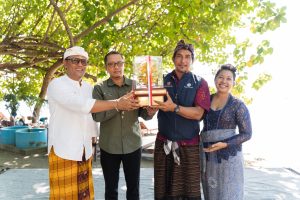
In the 1980s and 90s, the waters off Pemuteran, Bali, were not the vibrant turquoise postcards they are today. Instead, they were a silent, gray graveyard of shattered white skeletons. Years of destructive “blast” fishing—the practice of using fish bombs and potassium cyanide—had reduced a once-thriving ecosystem into a barren wasteland. But where nature was forced into retreat, a revolutionary “electric resurrection” has taken hold. Today, Pemuteran stands as a global beacon of marine hope, a transformation personified by Komang Astika, whose pioneering work recently earned him Indonesia’s highest environmental honor.
A National Triumph Against All Odds
On June 11, 2026, in Jakarta, the Ministry of Environment awarded Komang Astika the prestigious Kalpataru Award. The selection was no small feat; the Pemuteran team emerged as the winner from a competitive field of over 200 participants across the Indonesian archipelago. While the award itself is historic, the specific category is what tells the real story: Astika was honored as a Pembina Lingkungan (Environmental Mentor/Pioneer).
This distinction signals a critical shift in Indonesia’s environmental strategy. Winning as a “mentor” suggests that the success of Pemuteran is no longer viewed as an isolated success story, but as the spark for a scalable national network. It recognizes that Astika’s greatest contribution isn’t just the coral he has planted, but the movement he has cultivated by guiding others to replicate this success in their own waters.
The Counter-Intuitive Power of “Electric” Coral

To the uninitiated, the idea of pumping electricity into the ocean sounds like a recipe for disaster. However, the Biorock technology employed by Astika is a masterclass in elegant bio-engineering. By running a low-voltage current—safe enough for humans and marine life to touch, often compared to the voltage of a simple battery—through submerged metal structures, a process of electrolysis is triggered. This causes dissolved minerals to precipitate out of the seawater, coating the metal in a thick layer of calcium carbonate.
Essentially, the technology creates “instant limestone,” the very material coral reefs are built upon. Because the coral polyps no longer have to expend energy creating their own limestone skeletons, they can divert all their resources toward growth and immune defense. The result is coral that grows three to five times faster than normal and possesses a remarkable resilience against rising sea temperatures. It is a surprising, high-tech intervention that provides the physical “hardware” necessary for a reef to rebuild itself in record time.
A Blueprint for the Rest of Indonesia
Pemuteran is no longer just a destination; it has become a global R&D laboratory for marine science. As a co-founder of Biorock Indonesia, Komang Astika has turned his home village into a “Learning Center” where communities from across the country come to study. To date, this influence has resulted in the establishment of 17 Biorock sites across Indonesia, including the high-profile CMC 3 Warna project in Malang and the restoration efforts in Pejarakan, Bali.
“The success in Pemuteran has transformed the village into a national reference point, serving as both a global R&D hub and a proven blueprint for the effective recovery of Indonesia’s vast marine ecosystems.”
The Secret Ingredient is Traditional Community Guarding
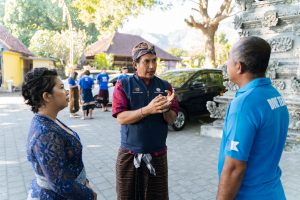
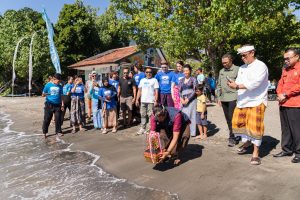
While the Biorock structures provide the hardware, the “social software” that protects the reef is rooted in ancient Balinese tradition. The long-term survival of the two-hectare restoration site is managed by a unique synergy between the Yayasan Karang Lestari (the management foundation) and the POKMASWAS Pecalang Segara—the traditional community sea guards.
This is the antithesis of top-down, bureaucratic conservation. By involving the Pecalang as the primary owners and supervisors, the project ensures that those who rely on the sea for their livelihood are the ones policing it. When the local community views the reef as their own inherited property rather than a government-protected zone, the incentive for protection becomes cultural and economic rather than merely legal. This blend of cutting-edge technology and ancestral wisdom is the true secret to the project’s sustainability.
Turning Environmentalism into a Blue Economy Model
The restoration of the reef has fundamentally rewritten the local economy. By reviving two hectares of marine habitat, Pemuteran has transitioned into a premier “Blue Economy” model, where environmental health directly fuels sustainable tourism and local prosperity.
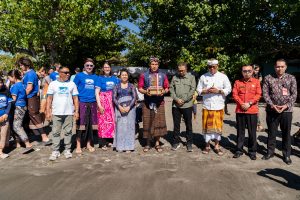
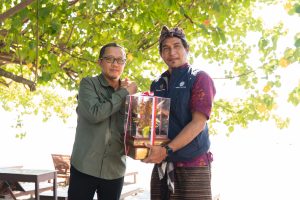
This achievement was celebrated locally on June 30, 2026, in a ceremony that bridged regional lines. In a notable gesture of cross-regional support, the Kalpataru trophy was officially handed over to Komang Astika by I Gede Putra Aryana, S.Sos., M.A.P., the Head of the Environment Agency of Gianyar Regency (Kepala Dinas Lingkungan Hidup Kabupaten Gianyar). This celebration marked the official homecoming of an award that symbolizes decades of dedication, proving that a dead reef can indeed be brought back to life.
Conclusion: The Future of Our Oceans
The legacy of Komang Astika and Biorock Indonesia offers a powerful rebuttal to environmental fatalism. It proves that when human ingenuity is applied through the lens of community tradition, we can do more than just “sustain” nature—we can actively heal it. What was once a graveyard of broken coral is now a thriving laboratory. As we look to the future, we must ask ourselves: if low-voltage electricity and local guards can save a reef in Bali, what other “impossible” recoveries are waiting to happen when we pair the right technology with the right community?
Call to Action
The 17 Biorock sites currently thriving across Indonesia are only the beginning. You can directly support the expansion of this movement and help bring “electric resurrection” to more coastal communities by visiting our donation page.